The slider is the amount of B
At 0% the result is exactly Color A; at 100% it is Color B. At 50% both contribute equally within the selected mixing model.

ONELESS / COLOR
Two colors can meet at many points between their endpoints. Color Mixer puts both sources and the result in view while you choose how much of the second color to add. Switch between encoded sRGB and linear sRGB to understand why a simple channel average and an average of light can produce different middles.
Open Color Mixer. JavaScript powers the workspace; the full guide is available below.
UNDERSTAND THE RESULT
At 0% the result is exactly Color A; at 100% it is Color B. At 50% both contribute equally within the selected mixing model.
sRGB averages the stored channel values. Linear sRGB removes the transfer curve, averages linear light values, then encodes the result again. Neither option simulates subtractive paint or ink.
Swapping exchanges A and B and replaces the B amount with its complement. A 25% B mix becomes 75% B after the inputs exchange places, preserving the same result.
HOW TO USE IT
A WORKED EXAMPLE
At equal amounts, encoded sRGB produces #808080. Linear sRGB produces #BCBCBC because half the light is brighter than the midpoint of the encoded channel numbers.
EVERYDAY USES
Mix two existing tokens at a documented ratio and copy a third value for a draft design.
Compare mixing spaces before choosing a midpoint for a transition or illustration. Test the exported color in its actual context.
LOCAL WORKSPACE
The tool processes color values locally. It does not upload the input to a processing server or save it in browser storage. Leaving or reloading the page clears the working state. Copying places the selected result on your clipboard; sharing sends only the page address without your working values.
These tools describe sRGB colors. Browser decoding, color management and the display can affect what you see; they are not an ICC proofing workflow or a print-color guarantee. Read the site privacy policy for information about the surrounding website.
KEEP IT NEARBY
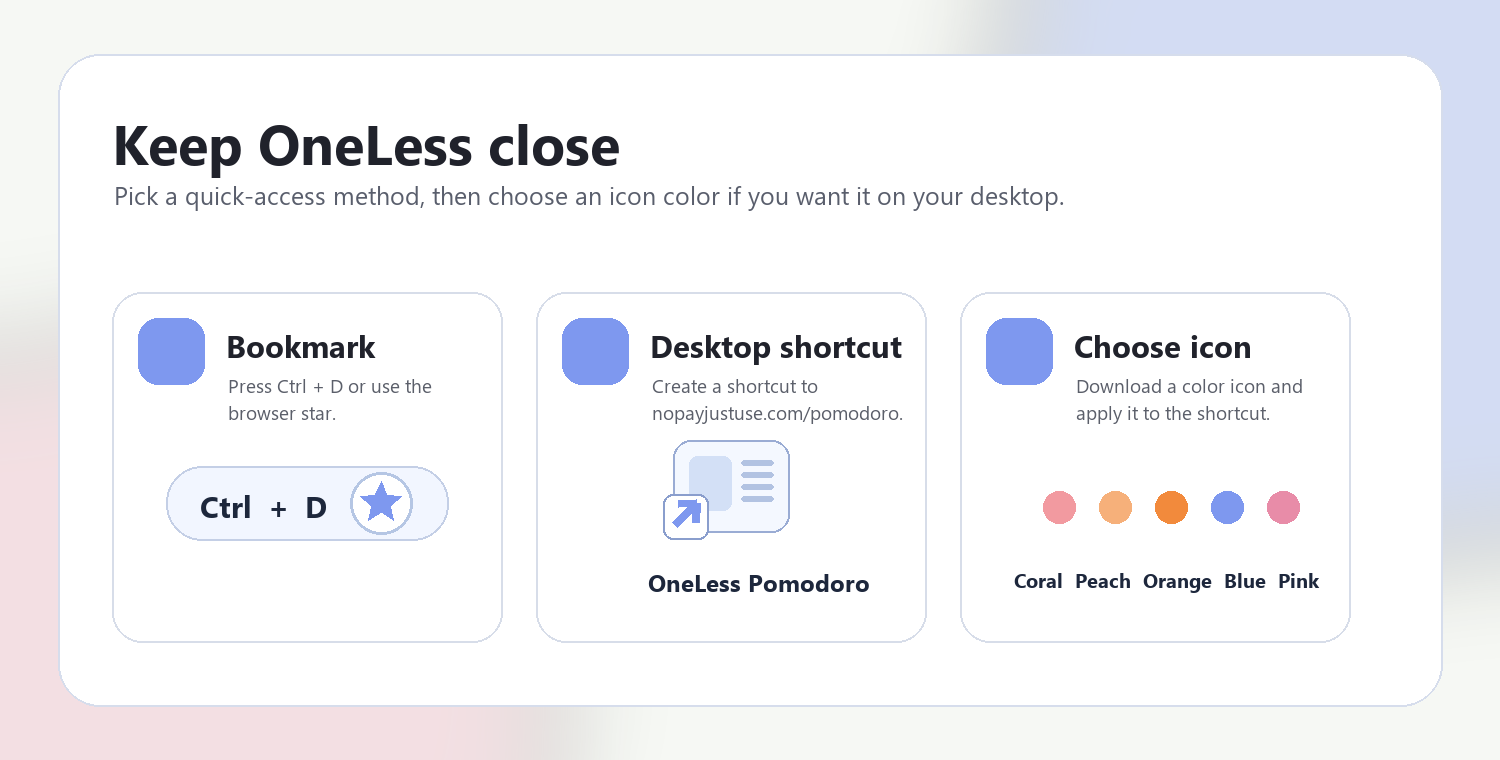
Press Ctrl + D on Windows or Command + D on Mac to bookmark this page. Your browser may also offer Create shortcut or Add to Home Screen. Shortcuts open the tool; they do not include your colors or images.
QUESTIONS, ANSWERED
No. These models mix digital RGB values and light, not pigments.
This tool accepts opaque HEX only. It avoids silently choosing an alpha-compositing rule.
Encoded sRGB channels are nonlinear with respect to light. The linear option decodes that curve before averaging.
The final HEX stores whole 8-bit channels. Calculations keep precision until the final conversion, then round to the nearest byte.
The percentage is the contribution of color B. At 0% you get A, at 100% B, and at 50% an equal mixture in the selected mixing space.
Swap also complements the mixing percentage so the same blend is preserved. It changes which color is considered A or B.
Yes. Copy the resulting value and use it as a new base in Color Picker, a palette tool or a contrast checker. The original inputs remain separate from the result.
REFERENCES
ANOTHER SMALL STEP
Find the point where two colors meet.
Return to Color Mixer ↑ Soft Coral
 Warm Peach
 Sunset Orange
 OneLess Blue
 Rose Pink