The base is preserved
The middle swatch is your original normalized HEX. The scale samples darker and lighter HSL lightness values on either side instead of replacing the base with a nearby calculated step.

ONELESS / COLOR
A single color often needs lighter surfaces and darker companions before it can become a useful interface palette. Color Shades Generator builds a compact HSL lightness scale around your exact base. Keep the original in the center, compare neighboring steps and inspect how black or white text reads on each one.
Open Color Shades Generator. JavaScript powers the workspace; the full guide is available below.
UNDERSTAND THE RESULT
The middle swatch is your original normalized HEX. The scale samples darker and lighter HSL lightness values on either side instead of replacing the base with a nearby calculated step.
Hue and saturation are retained while HSL lightness changes. The steps are not uniform perceptual distances, and different hues with equal HSL lightness can have very different contrast.
Selecting a step shows its contrast with pure black and pure white. These are informational ratios; decide which text threshold applies before choosing a label color.
HOW TO USE IT
A WORKED EXAMPLE
With #268C86 and nine steps, the fifth value is exactly #268C86. Four darker steps precede it and four lighter steps follow. Pure black or white inputs can produce repeated values on the side where lightness has no further room.
EVERYDAY USES
Use the generated list as a starting set of surface, border and accent tokens, then adjust and name them for the actual interface.
Inspect the black and white ratios on a desired step before assigning its label. Check the actual text size and context with WCAG Contrast Checker.
LOCAL WORKSPACE
The tool processes color values locally. It does not upload the input to a processing server or save it in browser storage. Leaving or reloading the page clears the working state. Copying places the selected result on your clipboard; sharing sends only the page address without your working values.
These tools describe sRGB colors. Browser decoding, color management and the display can affect what you see; they are not an ICC proofing workflow or a print-color guarantee. Read the site privacy policy for information about the surrounding website.
KEEP IT NEARBY
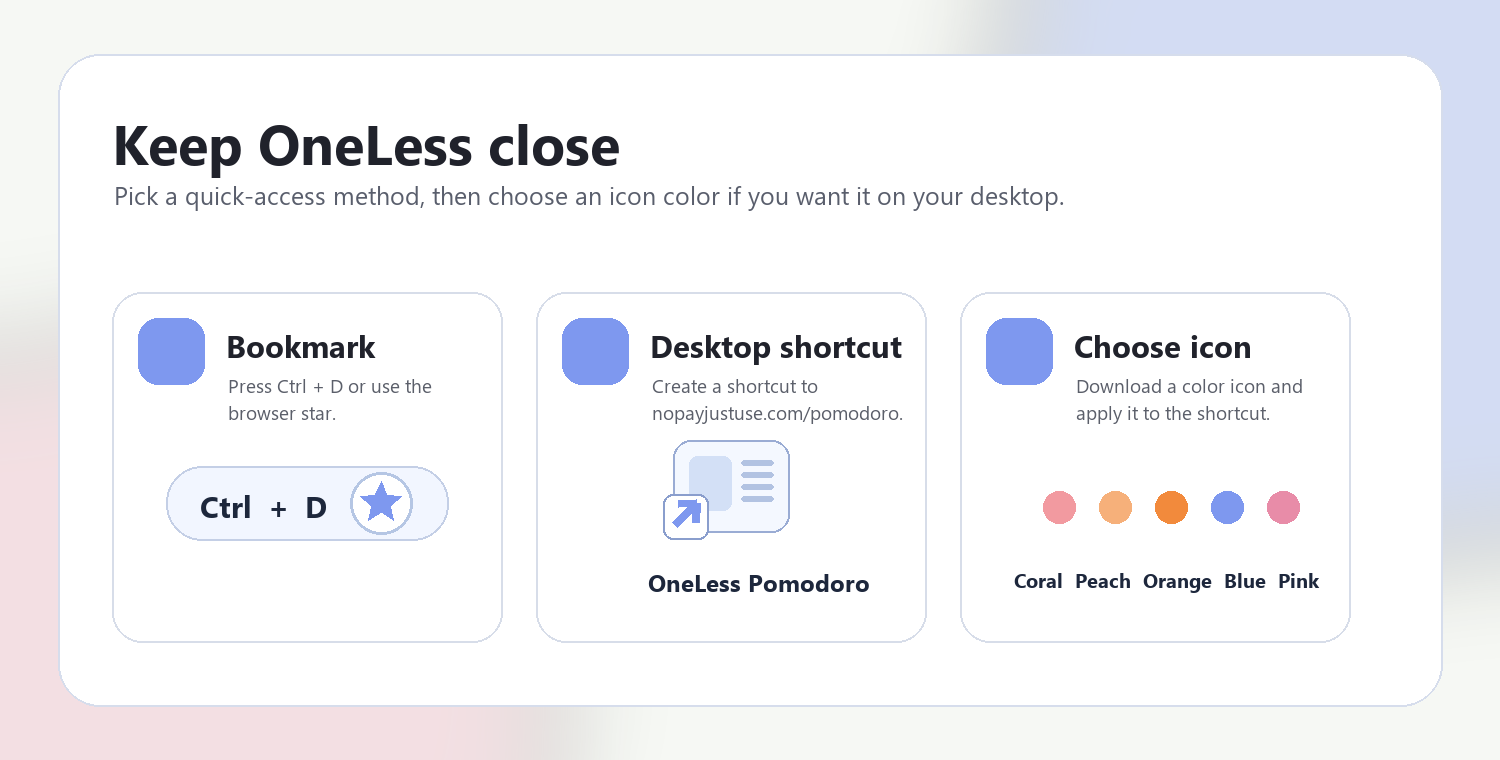
Press Ctrl + D on Windows or Command + D on Mac to bookmark this page. Your browser may also offer Create shortcut or Add to Home Screen. Shortcuts open the tool; they do not include your colors or images.
QUESTIONS, ANSWERED
This tool provides a complete dark-to-light scale around the base. Tint and Shade Generator separately shows explicit mixtures with white and black.
No. This is an HSL lightness scale, not OKLCH or another perceptual scale.
At black, white or very low chroma, rounding or the available lightness range can produce identical HEX values. The generator retains the requested steps and exact base.
No. It exports numbered --color-1 and subsequent variables with comments. Rename the values to match your project.
Yes. The base remains the middle reference swatch. The surrounding steps provide lighter and darker options to compare.
Use five steps for a compact range or seven or nine when you need more intermediate choices. Extra steps are options, not a requirement to use every color.
No. Check the specific pair you will use. Position in a scale is not an accessibility pass or a substitute for contrast measurement.
REFERENCES
ANOTHER SMALL STEP
A scale of light and dark, built around your color.
Return to Color Shades Generator ↑ Soft Coral
 Warm Peach
 Sunset Orange
 OneLess Blue
 Rose Pink