The darkest shared component becomes black
Normalize RGB to 0–1 and let K = 1 − max(R, G, B). The remaining C, M and Y values are calculated relative to that maximum. Pure black uses C 0%, M 0%, Y 0%, K 100% to avoid division by zero.

ONELESS / COLOR
RGB to CMYK expresses a screen color as four approximate ink percentages using a simple mathematical model. Enter RGB channels or a function, inspect the source color and read cyan, magenta, yellow and black together. The result is a reference calculation, not a press-ready separation or an ICC-managed conversion.
Open RGB to CMYK. JavaScript powers the workspace; the full guide is available below.
UNDERSTAND THE RESULT
Normalize RGB to 0–1 and let K = 1 − max(R, G, B). The remaining C, M and Y values are calculated relative to that maximum. Pure black uses C 0%, M 0%, Y 0%, K 100% to avoid division by zero.
CMYK percentages here describe an opaque input. A transparent RGB color must be composited onto the intended background before it has a single screen appearance to convert.
Profiles, black generation and ink limits belong to a production print workflow. The four percentages here do not certify ink coverage or reproduce a specific printer, paper or press.
HOW TO USE IT
A WORKED EXAMPLE
For rgb(51, 102, 153), the normalized maximum is 0.6. The result is C 66.67%, M 33.33%, Y 0%, K 40%. This is one mathematical separation, not a claim about a particular print process.
EVERYDAY USES
Compare red, white and black endpoints and see which CMYK channels change in this formula.
Copy the labeled values when a rough reference is sufficient. Use a color-managed application and the printer’s output profile for final production.
LOCAL WORKSPACE
The tool processes color values locally. It does not upload the input to a processing server or save it in browser storage. Leaving or reloading the page clears the working state. Copying places the selected result on your clipboard; sharing sends only the page address without your working values.
These tools describe sRGB colors. Browser decoding, color management and the display can affect what you see; they are not an ICC proofing workflow or a print-color guarantee. Read the site privacy policy for information about the surrounding website.
KEEP IT NEARBY
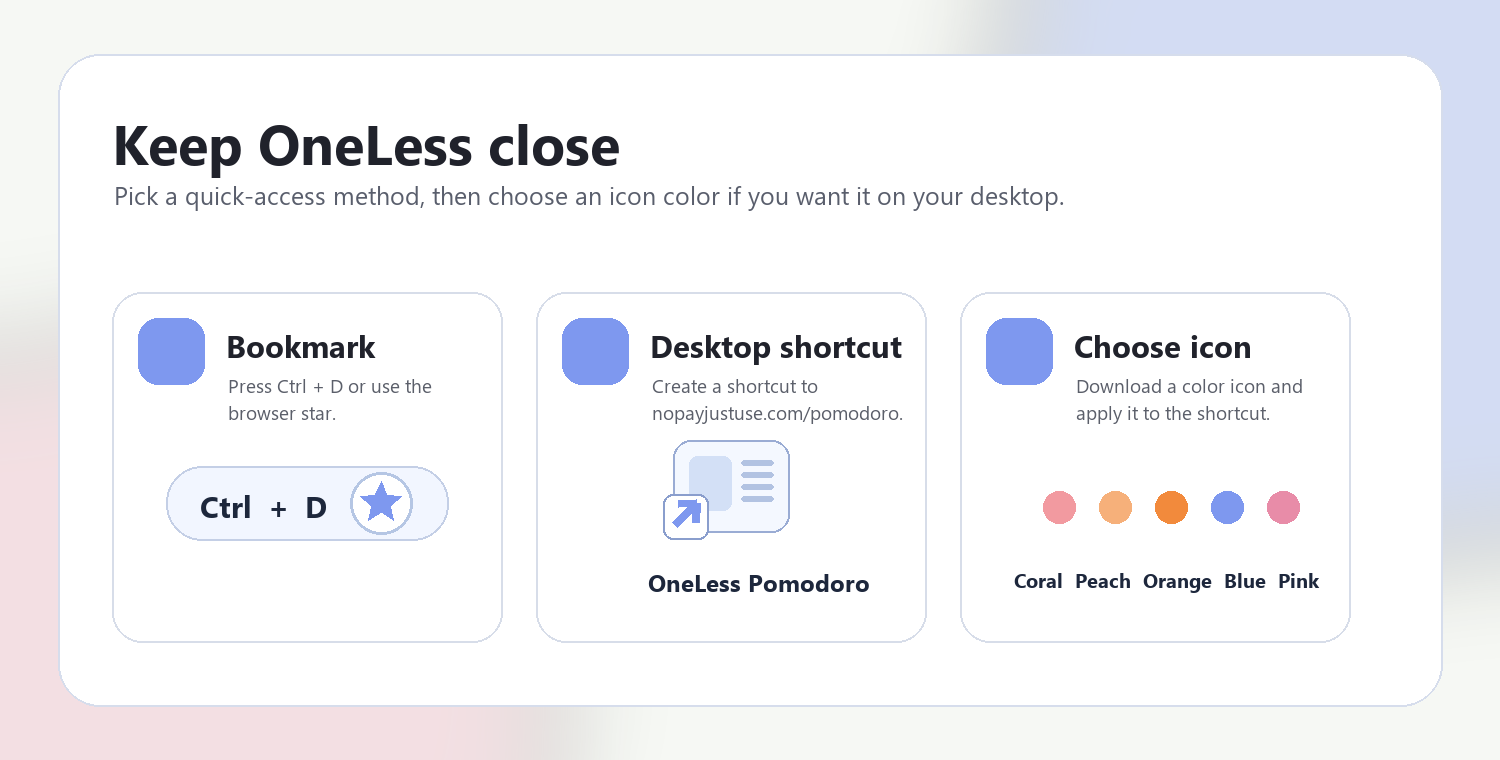
Press Ctrl + D on Windows or Command + D on Mac to bookmark this page. Your browser may also offer Create shortcut or Add to Home Screen. Shortcuts open the tool; they do not include your colors or images.
QUESTIONS, ANSWERED
Copy CMYK produces a labeled text report, not a CSS declaration. Use the HEX button for an ordinary screen-color value.
No. Different combinations can lead to the same RGB in a simple model. This tool chooses the black component from the maximum RGB channel.
Percentages are copied with two decimals and HEX uses whole bytes. Those rounding steps can cause small differences on a later conversion.
Only an alpha of 1 is accepted. Composite partially transparent colors onto the intended background first.
The profile-free calculation returns 0% cyan, 0% magenta, 0% yellow and 100% black. It does not prescribe a rich-black ink recipe for printing.
CMYK expresses cyan, magenta, yellow and a separate black component. RGB describes red, green and blue light, so the representations serve different workflows.
No. CMYK values are percentages from 0 to 100, while byte-form RGB channels run from 0 to 255. Keep the units when passing values to another application.
REFERENCES
ANOTHER SMALL STEP
Read a screen color as approximate ink percentages.
Return to RGB to CMYK ↑ Soft Coral
 Warm Peach
 Sunset Orange
 OneLess Blue
 Rose Pink