Camera, date and location metadata detached from a photograph.

ONELESS · IMAGE LIGHT

EXIF Remover

Before a picture travels, it helps to decide which extra information should travel with it. EXIF Remover creates a separate copy, removes supported personal metadata, and reads the output again before enabling download. The default method preserves compressed image data and keeps the display orientation and selected color information explicit. A separate PNG-copy method is available when you want every original EXIF tag removed.

Open EXIF Remover · This tool needs JavaScript for image processing. The complete guide is available below.

UNDERSTAND THE RESULT

A little context before the next click.

Removing metadata is not redacting pixels

Camera details, recorded location, dates, comments, and author fields live outside the main picture data. Removing them does not blur a face, hide a street sign, erase a watermark, or remove information visible in the image. The original remains unchanged on your device.

Preserve compressed pixels

The default method rewrites supported JPEG, PNG, or WebP containers without re-encoding the compressed picture data. It removes EXIF blocks, XMP, comments, and other nonessential metadata. If a display orientation is required, a new minimal EXIF block retains only that tag. Color profiles and supported color instructions are kept when the checkbox is enabled.

A PNG copy for complete EXIF removal

PNG-copy mode decodes the displayed image, applies its orientation through the browser, and creates a new PNG. It does not copy original EXIF or ICC profiles. This avoids retaining an orientation tag, but it rebuilds the pixel representation and browser color handling can change appearance. A PNG can also be much larger than a JPEG or WebP.

HOW TO USE IT

From an original to a clear next step.

  1. Choose or drop a still JPEG, PNG, or WebP. The original image and metadata block count appear before any cleaned file is created. Sample includes synthetic camera and GPS data.
  2. Select the same-format method to preserve compressed image data, or PNG copy to remove every original EXIF tag. In same-format mode, decide whether color profiles and color instructions should remain.
  3. Select Create cleaned copy. The tool scans the output again and checks that it can be decoded for preview. A parse or verification failure leaves download disabled.
  4. Review the retained-block count, orientation and color notices, dimensions, size, and original/result previews. Download saves a separate file named cleaned-image with the appropriate extension.

EVERYDAY USES

Small image tasks, with room to see.

A photo for a public post

Remove recorded camera, GPS, date, and author fields from a copy. Check the visible image as well; metadata removal cannot hide details printed or photographed into the scene.

A graphic with a color profile

Keep the profile when appearance matters, while noting that profile data can contain attribution. Turn that option off or choose PNG copy when retaining the original profile is not appropriate.

A rotated camera photo

The default method preserves the stored pixels and retains only the display orientation tag. PNG-copy mode bakes the displayed orientation into new pixels and removes the tag. Compare the result before saving.

YOUR IMAGE, YOUR DEVICE

Local processing. A separate result.

The image and its metadata are processed in this browser. This tool does not upload them or save them in browser storage. Clear releases the working image, and leaving the page releases temporary image URLs. Downloads and clipboard copies remain wherever you save or paste them. Sharing the tool includes only its address, without your file, tags, or location.

The download is a separate copy with a generic filename. Same-format output can retain a minimal display-orientation tag and an explicitly selected color profile. PNG-copy mode renders a fresh pixel image and removes original metadata. Neither method redacts identifying information visible in the picture or guarantees forensic anonymity.

Removal supports still JPEG, PNG, and WebP up to 25 MB, 16 MP, and 16,384 pixels per side. Output metadata is scanned again and decoded for preview. The verification covers this tool’s supported containers and fields; it is not a claim to recognize arbitrary steganographic content inside image pixels.

Read the site privacy policy for the surrounding website.

File sizes and limits use decimal units: 1 KB = 1,000 bytes and 1 MB = 1,000,000 bytes. Rounded labels are for readability; target checks compare exact bytes.

KEEP IT NEARBY

One less search next time.

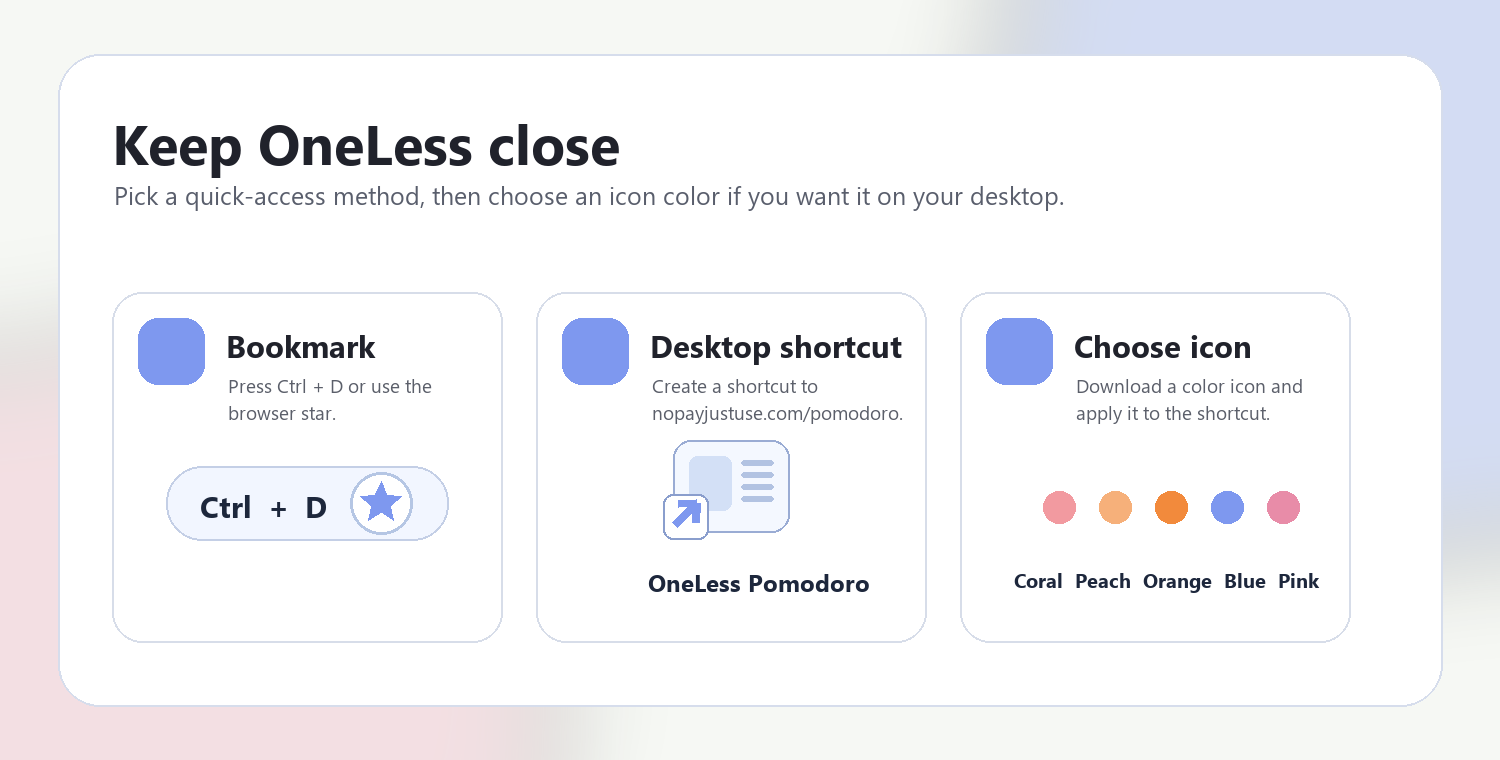
Bookmark this page with Ctrl + D on Windows or Command + D on a Mac. To make a desktop shortcut, use your browser’s shortcut or Add to Home Screen option when available. The shortcut opens the tool page; it does not include your image or settings.

Guide to adding a OneLess browser shortcut

Choose a OneLess shortcut icon

Download a PNG or ICO if your device lets you customize shortcut icons.

QUESTIONS, ANSWERED

Before you save or share.

Does default mode remove every EXIF tag?

It removes personal EXIF fields, but retains a newly created orientation-only EXIF block when needed to keep the picture upright. The result explicitly lists this exception. Choose PNG copy to remove all original EXIF tags.

Is XMP removed too?

Yes. Supported JPEG APP1/APP13/comment metadata, PNG text and EXIF chunks, and WebP EXIF/XMP chunks are removed in the same-format method. Nonessential unknown application or ancillary data is also dropped.

Why can metadata blocks remain?

Rendering headers, a minimal orientation tag, or an intentionally retained color profile may remain. The count is an inventory, not an assertion that all remaining blocks are personal data. The result explains the important exceptions.

Can quality change?

The default method preserves compressed image bytes, but removing color instructions can affect interpretation. PNG-copy mode decodes and renders pixels through the browser. It is not a byte-preserving export, even though the new PNG encoding is lossless.

What if EXIF is damaged?

The same-format method refuses ambiguous or unreadable EXIF because removing it blindly could change display orientation. PNG-copy mode may work if the browser can still decode the image. Invalid image containers remain unsupported.

Can it clean animations?

This release supports still-image removal only. Animated files can be viewed in EXIF Viewer, but the remover does not flatten them or promise to clean every frame.

ANOTHER SMALL TASK?

Keep the next step close.

Ready for the image in front of you?

Choose what stays with your image. Save a checked, separate copy.

Return to EXIF Remover ↑