A photograph and camera metadata showing exposure settings.

ONELESS · IMAGE LIGHT

EXIF Viewer

A photograph can carry information beyond the picture itself: a camera model, a recorded date, exposure settings, or a location. EXIF Viewer puts those records beside the image so you can inspect what is actually present. It reads supported EXIF fields and lists other metadata blocks separately. Missing values stay missing; the tool does not infer a date, a device, or a place from the visible scene.

Open EXIF Viewer · This tool needs JavaScript for image processing. The complete guide is available below.

UNDERSTAND THE RESULT

A little context before the next click.

File records, not proof

Metadata can be edited, copied, removed, or added by software. A recorded camera model or date is a field in the file, not proof that a particular person took the image at that time. Use these values as technical context and keep the original when provenance matters.

Decoded tags and detected blocks

Common EXIF image, camera, GPS, thumbnail, and interoperability fields are decoded. Unknown TIFF tags can appear by their hexadecimal identifier. Maker notes remain binary summaries. XMP, IPTC, ICC profiles, comments, and text blocks are detected but their complete contents are not interpreted in this release.

Recorded time and location

Dates are shown without inventing a timezone. A UTC offset is a separate field when present. GPS latitude and longitude are calculated only from valid coordinate values and direction references. Incomplete GPS information is identified without guessing the missing pieces.

HOW TO USE IT

From an original to a clear next step.

  1. Choose or drop one JPEG, PNG, or WebP image. Sample uses synthetic metadata attached to a demonstration illustration, including example coordinates at zero latitude and longitude.
  2. Read the EXIF tag count, location status, and other-block count. The image panel shows orientation-adjusted dimensions, file size, and detected format.
  3. Search by a tag name, identifier, or value, and use the group selector to inspect camera fields, GPS, or other blocks. The field list scrolls while the surrounding controls stay available.
  4. Copy the complete report or save JSON when you need a record. These exports may contain filenames, location, and identifying metadata. Open map is optional and sends coordinates to Google only when you select the link.

EVERYDAY USES

Small image tasks, with room to see.

Review a photo before sharing

Look for location, artist, copyright, serial numbers, and recorded dates. Use EXIF Remover separately when you want a cleaned copy; reading the fields does not remove anything.

Understand capture settings

Check exposure time, aperture, ISO, focal length, and white balance where the camera stored them. The viewer cannot recover settings that were never recorded or that another editor removed.

Explain a rotated image

The orientation tag tells compatible viewers how to rotate or mirror stored pixels. Displayed width and height can be swapped relative to stored dimensions even though the image data is unchanged.

YOUR IMAGE, YOUR DEVICE

Local processing. A separate result.

The image and its metadata are processed in this browser. This tool does not upload them or save them in browser storage. Clear releases the working image, and leaving the page releases temporary image URLs. Downloads and clipboard copies remain wherever you save or paste them. Sharing the tool includes only its address, without your file, tags, or location.

The report includes the original filename, measurements, decoded tags, metadata block inventory, parser warnings, and validated coordinates when present. Review it before sharing it with someone else. The preview may apply a stored orientation or animate without changing the original bytes.

Inputs are limited to 25 MB, 16 MP, and 16,384 pixels per side. EXIF directory traversal, tag counts, and displayed values are bounded; long values are explicitly truncated. Detection of known blocks is not a guarantee that every possible hidden or proprietary field has been interpreted.

Read the site privacy policy for the surrounding website.

File sizes and limits use decimal units: 1 KB = 1,000 bytes and 1 MB = 1,000,000 bytes. Rounded labels are for readability; target checks compare exact bytes.

KEEP IT NEARBY

One less search next time.

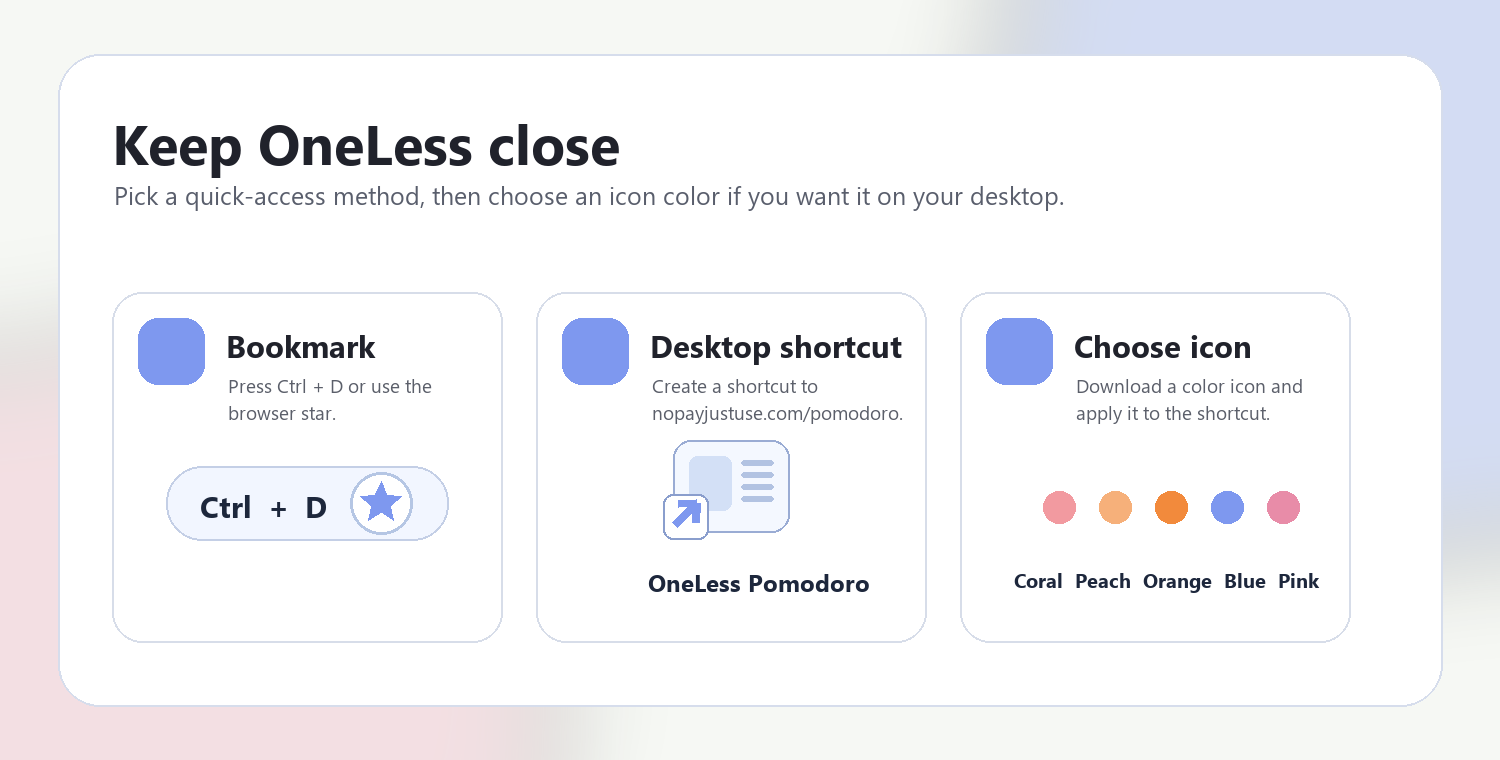
Bookmark this page with Ctrl + D on Windows or Command + D on a Mac. To make a desktop shortcut, use your browser’s shortcut or Add to Home Screen option when available. The shortcut opens the tool page; it does not include your image or settings.

Guide to adding a OneLess browser shortcut

Choose a OneLess shortcut icon

Download a PNG or ICO if your device lets you customize shortcut icons.

QUESTIONS, ANSWERED

Before you save or share.

Does this show every kind of metadata?

No. It decodes common TIFF-based EXIF fields and detects other supported container blocks. Proprietary maker notes and the full XMP, IPTC, and ICC contents are not expanded. The coverage note stays visible beside the field list.

What does No EXIF block found mean?

No supported EXIF block was detected. Other metadata may still exist, and an image without EXIF can still reveal personal information in its visible pixels or filename.

What happens with damaged EXIF?

A bounded parser reports partial reads or invalid offsets. Successfully read values can remain visible, with a warning. A malformed image container or an undecodable image prevents a normal result.

Are coordinates sent to a map automatically?

No. Coordinates are displayed as text. Only selecting Open map sends them to the external map service. No map tiles are loaded in the workspace.

Will the original change?

No. The tool reads the original and creates only text reports. It does not rewrite or rotate the file.

Which files are supported?

JPEG, PNG, and WebP up to 25 MB, 16 megapixels, and 16,384 pixels on either side. TIFF files, HEIC, GIF, RAW camera formats, and video are not supported. Animated PNG or WebP can be inspected when the browser can display them.

ANOTHER SMALL TASK?

Keep the next step close.

Ready for the image in front of you?

See the details stored with your picture, without changing it.

Return to EXIF Viewer ↑